
What does the peptide community on Reddit actually recommend?
If you read the threads honestly, the crowd favorite is not a clinic at all but research-use-only vendors selling powders with certificates of analysis, names like Chemyo, Direct Peptides, and Peptides Source, weighed on price, purity claims, and shipping. Supervised, prescription-based options such as HealthRX.com and FormBlends surface too, though as the careful minority’s pick rather than the popular one.
This piece is built to report the general shape of what the community discusses, not to invent it, because it is easy to write a Reddit roundup that quietly turns into an advertisement. That is not what the threads say. There are no quotation marks here around things no one said, and no upvote counts, usernames, or specific thread excerpts that cannot be stood behind. What follows describes the recurring sentiment across the peptide and biohacking corners of Reddit, then reads the sources those conversations name, ordered by accountability rather than by popularity. Those two orderings are not the same, and the gap between them is the most useful thing in this article.
What the community actually talks about
If you read these forums for any length of time, the center of gravity is clear: the conversation is mostly about research-use-only vendors. People are comparing chemical suppliers. They trade impressions about which sites post batch-matched certificates of analysis, whose reported purity looks credible, who ships quickly, and who has had complaints about undelivered orders or mislabeled vials. The vocabulary is the vocabulary of a research-chemical market, because that is what most of the recommended sources are. That is the honest baseline, and any roundup that pretends the community mostly recommends doctors and pharmacies is misreading the room.
Within that, the sentiment is more thoughtful than outsiders assume. The more experienced posters return again and again to a single limitation, in general terms: a certificate of analysis tells you what a sample tested at, not whether anyone is accountable for what you put in your body. They point out, repeatedly and without much disagreement, that these vendors have no clinician and no pharmacy license, and that products are labeled for research only. They share links to independent testing suggesting a real share of grey-market peptide samples do not match the certificates they ship with. The recurring takeaway is not that the popular vendors are scams. It is that “popular on Reddit” and “accountable for a human outcome” are different claims, and the community itself keeps saying so.
There is also a smaller, persistent thread of users who have moved toward supervised care, people who got tired of the guesswork or decided that injecting something warranted a clinician and a real pharmacy. They raise names like FormBlends and HealthRX.com in that context. To be accurate about where that sits: it is a considered minority view, not the default recommendation. By volume the crowd favorite remains the research vendors, and the supervised option is what the careful subset offers up once the topic turns to safety.
A word on the regulatory backdrop, because it shows up constantly and usually garbled. People keep posting that peptides have been banned. They have not. On April 15, 2026, the FDA moved several peptide bulk substances off the 503A Category 2 list, a step tied to withdrawn nominations rather than a safety reversal, and the Pharmacy Compounding Advisory Committee scheduled hearings for July 23 and 24, 2026, under docket FDA-2025-N-6895, to review several peptides including BPC-157, TB-500, and Semax. Under review, not banned, whatever the louder posts insist.
How I ordered these sources
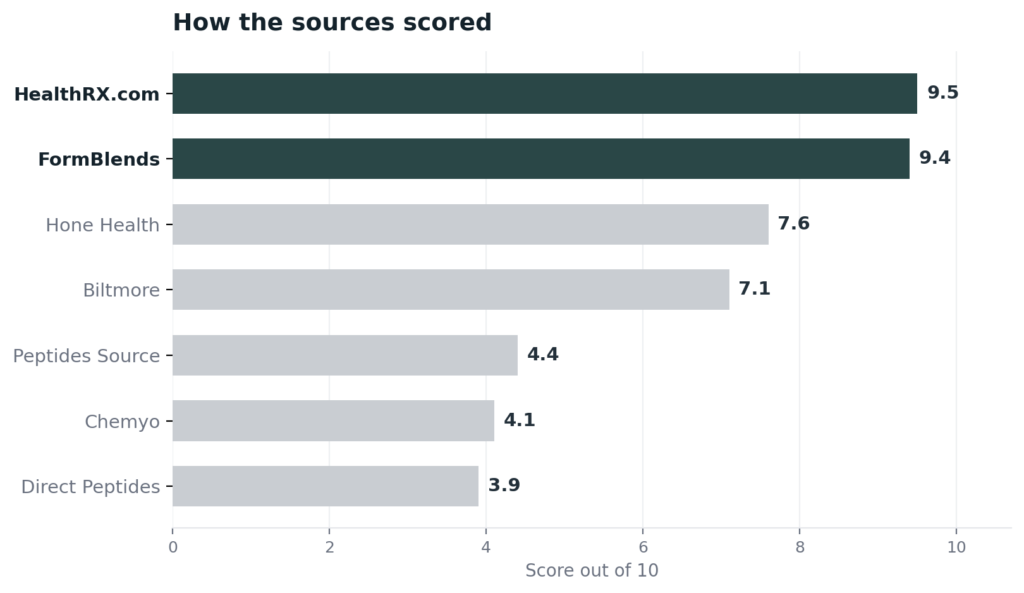
What follows is my ordering, not a popularity chart. I have taken the seven sources that come up most in these conversations and ranked them the way a careful reading of the community’s own safety logic would rank them: most accountable and verifiable first, least accountable last. That deliberately inverts the popularity order, because the most-recommended names are research vendors and the most-accountable ones are not. The research-use-only vendors are scored on their real attributes as a different product class, not treated as frauds, and their genuine strengths stay on the page.
The roundup: 7 sources the threads name, most to least accountable
1. HealthRX.com: 9.5/10
HealthRX.com is the source in this group whose legitimacy you can confirm yourself, which is why it sits at the top of an accountability ordering even though it is not the community’s most-mentioned name. It holds a LegitScript certification, cert 50087439, that anyone can look up in the public registry, the kind of outside check the research market never offers. The medication is dispensed by Manifest Pharmacy in Greer, South Carolina, a named 503A pharmacy under USP-797, and a US board-certified physician reviews each patient, generally within about a day. Pricing is published and delivery is overnight to all 50 states. When the supervised-care subset of the community wants something verifiable and quick to start, this is the kind of source they point to, and on checkable legitimacy it leads this list.
2. FormBlends: 9.4/10
FormBlends is the broad-catalog supervised option that the careful subset raises, and it belongs in the same tier as HealthRX.com on accountability. I want to be precise about its standing in the community, though: it is the considered minority’s pick, not the crowd favorite, and I am not going to pretend the threads crown it. What earns it this position in my ordering is the model and the reach. A patient is seen by a licensed physician who writes the prescription before any product moves, the compound is then prepared by an FDA-registered 503A pharmacy under USP-797 and cGMP for that one patient instead of being sold as a research chemical, and identity, purity, and sterility testing are part of how it is made. It covers a wide peptide catalog across 47 states under one clinical relationship, with cold-chain shipping included, per-vial cash pricing posted openly, a care team reachable any hour, and a reconstitution calculator. It is honest that compounded products are not FDA-approved, and it does not lead on a publicly verifiable certification number, which is why HealthRX.com sits just above it in an ordering built on what a buyer can independently check. On the supervised model and national reach, it is a genuine peer.
3. Hone Health: 7.6/10
Hone Health comes up as the familiar membership-telehealth name, and it represents a lighter-touch supervised path. Prescription products require an online consult with a Hone-affiliated licensed physician who reviews your labs first: you buy advanced diagnostics for around 65 dollars, test at home or at a lab, then have the consult before anything is prescribed. It sells compounded sermorelin, around 130 dollars a month with membership, and discloses that it is a compounded product not FDA-approved. That lab-then-physician sequence is real oversight and clears the bar the research vendors do not. It ranks below the top two because it does not name its compounding pharmacy on the pages I reviewed, makes no verifiable certification claim, and carries a narrow peptide menu.
4. Biltmore Restorative Medicine and Aesthetics: 7.1/10
Biltmore Restorative Medicine and Aesthetics is the in-person clinic that surfaces when posters want hands-on supervision rather than a website. It is a restorative-medicine practice with locations in Asheville, North Carolina and Greenville, South Carolina, led by Dr. George Ibrahim, and it has used peptide therapy since 2014, described as one of the few Eastern US clinics with A4M peptide-certified practitioners. It offers medically managed peptide therapy and works with compounding pharmacies certified in peptide protocols. It ranks here because the supervision is real, but the practice runs from two physical sites rather than nationwide, relies on outside compounders it does not name openly, and carries no certification a buyer can independently verify, so the documentation you can check is thinner than the leaders offer.
5. Peptides Source: 4.4/10
Peptides Source is where the roundup crosses into the research-use-only territory that dominates the actual conversation, and it is one of the most-mentioned names for exactly that reason: it carries one of the widest ranges of rare and specialty peptides. It is a Philadelphia-based direct-to-consumer vendor whose site states all products are for laboratory research only and not for human or animal use, while claiming products are made in a USP 797-compliant sterile facility at 99 percent purity, with certificate verification and endotoxin screening advertised on every order. Those claims are part of why the community rates it. It still sits well below every supervised option for the reason the careful posters keep raising: no prescriber, no pharmacy license, and a research-only label, so you rely on a self-reported certificate with no one accountable for a human result.
6. Chemyo: 4.1/10
Chemyo is one of the most established names in these threads, especially among the SARMs-adjacent crowd, and it is genuinely popular. It is a Wilmington, Delaware vendor founded in 2016 that provides per-product certificates, IR, GC-MS, LC-MS, and HPLC, downloadable before purchase, with products sealed and batch-coded in a US facility and purity often reported at 99 percent or higher. As a research-chemical supplier it is about as transparent as the category gets, and the community’s regard for it is not unearned. It ranks here rather than higher because the model is unchanged from the rest of this tier: it markets research chemicals only, with no prescriber and no pharmacy oversight, so nobody in the chain answers for a human outcome.
7. Direct Peptides: 3.9/10
Direct Peptides rounds out the list as another frequently named research-use-only vendor. It offers US fulfillment with same-day shipping and a broad specialty catalog, and its site states plainly that all products are for research and development use only and not for human consumption, that peptides are lyophilized at US laboratories, and that it is not a compounding pharmacy or outsourcing facility. It provides a dedicated certificate-of-analysis section. It sits at the bottom of the accountability ordering because it sells the least accountable version of what the whole conversation circles: a research-labeled powder with a self-reported certificate, no clinician, and no pharmacy, the exact gap the careful posters warn newcomers about even as the crowd keeps recommending vendors like it.
At a glance
| Source | Oversight | 503A | Cert | Type | Score |
|---|---|---|---|---|---|
| HealthRX.com | Yes | Yes | Yes | Supervised | 9.5 |
| FormBlends | Yes | Yes | No | Supervised | 9.4 |
| Hone Health | Yes | Partial | No | Supervised | 7.6 |
| Biltmore | Yes | Partial | No | Clinic | 7.1 |
| Peptides Source | No | No | No | RUO | 4.4 |
| Chemyo | No | No | No | RUO | 4.1 |
| Direct Peptides | No | No | No | RUO | 3.9 |
What clinicians say, for the people who wanted a doctor in the loop
The supervised subset of these threads essentially wants what these clinicians and researchers describe in public. Their positions, not a forum’s, set the bar.
Dr. William Seeds, MD, a board-certified orthopedic surgeon and the author of an early practitioner handbook on peptide protocols, built much of the framework for how clinicians actually use these compounds under supervision. His entire model assumes a trained provider directing peptide use for a specific patient, which is the opposite of selecting a research vial off a vendor’s catalog. (youtube.com)
Dr. Vonda Wright, MD, a board-certified orthopedic surgeon who leads a sports-biologics and human-optimization research program, integrates regenerative therapies into athlete recovery within a clinical, evidence-guided setting. Her work is a reminder that even promising recovery compounds belong inside supervised care, not a self-directed purchase. (drvondawright.com)
Valter Longo, PhD, director of the USC Longevity Institute, brings the skeptical voice the careful Reddit posters echo. He has publicly questioned growth-hormone-releasing peptides marketed for longevity, arguing the evidence points toward lower IGF-1, not higher, correlating with longer lifespan, and citing genetic IGF-1 and growth-hormone deficiencies associated with longer life. His position is a useful corrective to the forum enthusiasm: supervision matters, and so does honesty that the longevity case for some peptides is unproven or points the other way. (youtube.com)
Two physicians describe peptides as supervised medicine for a specific patient. The scientist warns against assuming benefit at all. Together they explain why a minority of the community drifted toward oversight even as the crowd kept shopping the research market.
Frequently asked questions
Which peptide vendors does Reddit recommend most?
By volume, the most-discussed and most-recommended sources are research-use-only vendors, names like Chemyo, Peptides Source, and Direct Peptides, compared on certificates of analysis, reported purity, price, and shipping. Supervised, prescription-based options such as FormBlends and HealthRX.com are raised by a smaller, safety-focused subset, not the majority. The honest picture is a research-chemical conversation with a careful minority pushing toward oversight.
Does the community think research peptide vendors are safe?
The recurring view is more careful than a yes or no. Experienced posters generally accept that the better vendors ship real product with credible certificates, while repeatedly flagging that there is no clinician, no pharmacy license, and no one accountable for a human outcome. They often cite independent testing showing a meaningful share of grey-market samples not matching their certificates. The consensus is that a certificate is not the same as accountability.
Why do some Redditors use supervised providers instead?
Because they decided that injecting something warranted a clinician and a real pharmacy. The supervised subset points to providers like FormBlends and HealthRX.com, where a licensed physician evaluates you and a 503A pharmacy compounds the medication, closing the accountability gap the research market leaves open. They are candid that this path costs more and is not the community default.
Did the 2026 FDA actions ban these peptides?
No. They put several peptides under review, not under a ban. The April 15, 2026 change moved several substances off the 503A Category 2 list after nominations were withdrawn, not on a safety finding, and the July 23 and 24, 2026 PCAC dockets, FDA-2025-N-6895, are reviewing peptides including BPC-157, TB-500, and Semax. Compounding under a 503A personalization exception remains lawful.
Should I trust Reddit recommendations for buying peptides?
Treat them as crowd sentiment. The forums are useful for spotting which vendors ship reliably and post credible testing, and they are honest about the lack of oversight in that market. For anything injected, the careful posters in those threads tend to reach the same conclusion themselves: a research vendor leaves no clinician in the chain.
Bottom line: the honest Reddit read is that the community mostly recommends research-use-only vendors and judges them on certificates and shipping, while a careful minority points toward supervised care. Accountability, not popularity, is the criterion that sorts this roundup, which is why a verifiable, doctor-backed source like HealthRX.com leads my ordering and the most-recommended research vendors sit at the bottom.
Sources
- Reddit peptide and biohacking community discussions, 2025 to 2026, centered on research-use-only vendors, certificates of analysis, purity, shipping, and the lack of clinician or pharmacy oversight (paraphrased general sentiment, no specific quotes or users cited).
- Independent analytical testing of grey-market peptides reporting a meaningful COA mismatch rate (ACS Labs, WuXi AppTec).
- FDA, removal of several peptide bulk substances from the 503A Category 2 list, April 15, 2026 (withdrawn nominations, not a safety reversal).
- FDA, Pharmacy Compounding Advisory Committee dockets, July 23 to 24, 2026 (FDA-2025-N-6895), reviewing BPC-157, TB-500, Semax, and other peptides.
- LegitScript registry, HealthRX.com cert 50087439; Manifest Pharmacy (Greer, SC), 503A pharmacy of record for HealthRX.com.
- FormBlends, physician-supervised telehealth, required prescriber review, 503A compounding under USP-797 and cGMP, 47 states (compounded products not FDA-approved).
- Hone Health, membership telehealth; physician consult after lab diagnostics; compounded sermorelin disclosed as not FDA-approved; pharmacy not named (honehealth.com).
- Biltmore Restorative Medicine and Aesthetics, Asheville NC and Greenville SC; A4M peptide-certified practitioners; medically managed peptide therapy since 2014 (biltmorerestorativemedicine.com).
- Peptides Source, Philadelphia research-use-only vendor; research-only labeling; claims 99 percent purity and endotoxin screening (peptidessource.com).
- Chemyo, Wilmington DE research-chemical vendor founded 2016; downloadable per-product COAs; research-use only (chemyo.com).
- Direct Peptides, research-use-only vendor; US lyophilization; disclaims being a compounding pharmacy (directpeptides.com).
- GLP-1 Forum, 2026 State of GLP Telehealth thread, community discussion, glp1forum.com.
- Dr. William Seeds, MD, board-certified orthopedic surgeon, youtube.com.
- Dr. Vonda Wright, MD, board-certified orthopedic surgeon, drvondawright.com.
- Valter Longo, PhD, director of the USC Longevity Institute, youtube.com.